Who Captures the Rate Cut? Refinancing Heterogeneity and the Transmission of Monetary Policy
Abstract
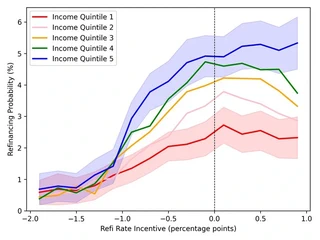
Mortgage refinancing responses to interest-rate declines differ sharply across the income distribution, and this heterogeneity materially weakens the transmission of monetary policy. The cross-income differential appears in both the intensity and timing of refinancing; the bottom income quintile refinances at only 60–65% of the top quintile’s rate and faces markedly longer delays even when refinancing is financially beneficial. These gaps persist after controlling for lender-side credit tightness, borrower credit quality, and origination lender selection, and the associated unrealized savings exceed 7.6% of monthly income for the bottom quintile. I further find that the dynamic refinancing response to identified monetary-policy easing is concentrated among higher-income borrowers, with the top-to-bottom quintile differential peaking at 4.3 percentage points. I develop a structural mortgage refinancing model that decomposes refinancing frictions into two distinct channels—inattention and hassle cost—and allows both to vary by income state. A homogeneous-friction benchmark fails to reproduce the observed income gradient; income-state-dependent frictions are necessary to match the data. A counterfactual intervention that raises refinancing attention by the magnitude documented in field evidence increases the five-year cumulative consumption response to a policy rate cut by approximately 10%, with roughly 80% of the additional response accruing to the bottom two income quintiles. This concentration reflects the joint distribution of refinancing frictions and marginal propensities to consume, and implies that attention-targeted interventions can simultaneously strengthen monetary transmission and compress wealth inequality.
Manuscript forthcoming. Draft available upon request.