Demographics and Housing Cycle
Abstract
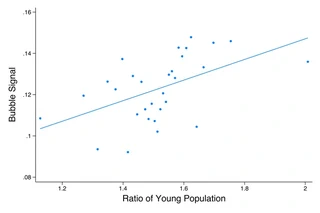
This paper studies whether demographic age structure is associated with housing-boom vulnerability. We define large housing booms as one-standard-deviation positive deviations of real house prices from location-specific trends. In an OECD panel of 29 countries over 1970–2021 and a U.S. county panel over 1975–2024, locations with higher young-to-old population ratios are more likely to experience large housing booms. In the country and time fixed-effects specification, a one-unit increase in the young-to-old ratio is associated with an 18.6 percentage-point higher boom probability; in the corresponding U.S. county specification, the estimate is 4.3 percentage points. HMDA mortgage data further show that young applicants increase mortgage-market participation disproportionately in boom county-years, with similar results for loan originations. To rationalize these facts, we study a six-generation housing OLG model with tenure choice, gradual price adjustment, adaptive house-price-growth beliefs, and age-specific income profiles. The model shows that a young economy can generate a larger house-price response to the same housing-preference shock when more households are located near the life-cycle tenure-adjustment margin.
Manuscript forthcoming. Draft available upon request.